Caravan battery and electrical issues have a habit of showing up at the worst time: you’re set up at camp, it’s getting dark and the lights won’t work. Or you wake up to a warm fridge and a battery that’s nearly flat. Not ideal, especially when you’re miles from the nearest town.
Before you assume the battery needs replacing, there are a few things worth checking. A loose connection, blown fuse or charging problem could be all that’s standing between you and a working setup.
This guide covers common problems with your 12V caravan electrical system and what to check first. Work through the steps in order, and stop if you find the fault. We’ll also explain when it’s time to call an auto electrician.
Find the problem that sounds most like yours and jump to the relevant step.
| Symptom | Most likely causes | Go to |
|---|---|---|
| Nothing works at all | Flat battery, isolator off, loose main connection, main fuse | Steps 1 to 3 |
| Some things work, others don't | Blown fuse or tripped breaker, bad earth | Steps 2 and 3 |
| One appliance is dead | Appliance fuse, loose connection, faulty appliance | Step 3 |
| Battery goes flat overnight | Parasitic drain, fridge setting, undersized or ageing battery | Step 5 |
| Won't charge from solar | Shade or dirt, regulator setting, loose connection | Step 4 |
| Won't charge while driving | Anderson plug, vehicle-side fuse, DC-DC charger | Steps 2 and 4 |
| Won't charge on 240V | Charger off or wrong battery setting, 240V fault | Step 4 |
| Lights dim or flicker | Low battery, corroded terminal, bad earth | Steps 1 and 2 |
| Battery is new but still weak | Charger setting, undersized battery | Steps 4 and 5 |
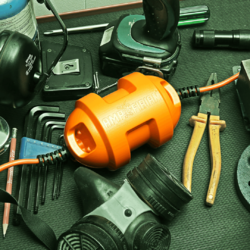
A few basic tools will help you get started:
There are also a few important safety rules to follow.
If you're not confident working around the battery or electrical connections, it's best to get an auto electrician to take a look.
If your lights are dim or your battery keeps cutting out, start by checking its voltage.
For lead-acid and AGM batteries, a resting voltage reading gives you an estimate of the state of charge, which is how much charge remains in the battery. It won't tell you whether the battery has lost capacity as it ages, but it's a useful starting point.
For a meaningful reading, the battery needs to be at rest. Charging can push the voltage up, while appliances drawing power can pull it down.
The figures below are approximate guides based on information from Trojan Battery for flooded lead-acid batteries and Lifeline for AGM batteries.
| State of charge | Flooded lead-acid | AGM |
|---|---|---|
| 100% | 12.73V | Above 12.78V |
| 80% | 12.50V | 12.54V |
| 60% | 12.27V | 12.30V |
| 50% | 12.10V | 12.18V |
| 40% | 11.89V | 12.06V |
| 20% | 11.66V | 11.82V |
These readings can vary with temperature and battery specifications, so check your manufacturer's guidance as well.
If you regularly discharge a lead-acid or AGM deep-cycle battery below about 50%, you can shorten its working life. These batteries are designed to supply power over longer periods, but repeatedly running them too low takes its toll.
Lithium batteries, including LiFePO4 models, behave differently. Their voltage stays fairly steady through much of the discharge cycle, so a voltage reading alone won't reliably tell you how much charge is left.
Use the battery's app or a battery monitor instead. A battery monitor measures the power going in and out, giving you a better picture of the remaining capacity.
If a lithium battery suddenly stops supplying power, its battery management system (BMS) may have switched it off to protect the battery. Low voltage is one possible reason, but excessive current, temperature or another fault can also trigger the protection system.
Check the battery's app and manual for any warnings. If it won't recover, contact the supplier rather than trying to open or repair the battery yourself.
When a charger or solar system is working, voltage will generally rise into the 13V or 14V range, depending on the battery type and charging stage.
If the voltage doesn't rise at all, the battery may not be receiving a charge. Head to Step 4 to check the charging system.
Keep in mind that a full battery, or one connected to a charger that's maintaining it at float voltage, may not show a significant increase.
If the battery has charge but your lights, pump or other equipment aren't working properly, check the connections before assuming something more serious is wrong.
A loose or corroded connection can interrupt the power supply, even when the battery itself is in good condition.
Look at the battery terminals for white or green build-up, which can indicate corrosion. Also check for any terminal that moves when lightly pressed. Don't force it or try to tighten it while the battery is connected.
Cleaning or tightening terminals can involve disconnecting the battery, so follow the manufacturer's instructions first. Bicarb soda and water can be used to clean some types of corrosion on lead-acid battery terminals, but check your battery manual before using any cleaning solution.
If you're unsure how to disconnect the battery safely, ask an auto electrician.
Your caravan's 12V electrical system needs a complete circuit for power to flow. The earth connection provides the return path to the battery's negative terminal.
If that connection is loose, corroded or damaged, you might notice strange electrical problems. For example, your lights might flicker when the water pump starts, or an appliance might work intermittently.
You can look for obvious damage around accessible connections, including the points where earth wires attach to the chassis. Leave hidden wiring and repairs to an auto electrician.
If your caravan battery isn't charging while you're driving, take a look at the Anderson plug connecting the caravan to your tow vehicle.
Check for visible damage, corrosion, burnt areas or contacts that look spread or loose. Make sure the two halves fit together securely.
If the plug or wiring looks damaged, don't try to repair it while connected. Have it checked before your next trip.
If one appliance or circuit has stopped working but the battery voltage looks fine, a blown fuse could be the culprit.
Depending on your caravan's setup, you'll usually find fuses in several places:
Check your caravan's manual if you're not sure where to look.
A blown blade fuse often has a broken metal strip inside. If you can't tell by looking, you can test it with your multimeter using the continuity setting.
First, follow your caravan's instructions to isolate the circuit and remove the fuse. Never use continuity mode on a live circuit.
If the fuse has blown, you can usually replace it yourself on the 12V side, provided you follow the manufacturer's instructions.
A fuse is there to protect the wiring. If it keeps blowing, fitting a bigger one won't fix the underlying problem and could create a fire risk.
If the battery connections and fuses look fine but the battery keeps running low, it's time to check the charging system.
Your caravan may charge from solar panels, your tow vehicle or a 240V mains connection. Each has a few things worth checking.
If your battery isn't charging from solar, start with these checks:
If everything looks fine but the battery still isn't charging, an auto electrician can test the system.
Start with the Anderson plug and the vehicle-side fuse. If both look fine, check the DC-DC charger's status lights or display.
A DC-DC charger takes power from your tow vehicle and regulates it to charge your caravan battery correctly.
Many modern tow vehicles use smart alternators, which adjust their output to improve fuel efficiency. Depending on the vehicle and electrical setup, you may need a compatible DC-DC charger to keep your caravan battery charging properly while you drive.
If you're replacing a charger, check that it's suitable for your vehicle, battery type and existing setup before ordering.
If you're connected to mains power but the battery isn't charging, check that the charger is switched on and configured for your battery type.
If those settings look right and the battery still won't charge, the problem may be with the charger or the 240V supply. Leave electrical testing and repairs on the 240V side to a licensed electrician.
Need a replacement charger or battery monitor? Browse our caravan power supply range. Check the specifications and make sure the product suits your battery before buying.
If you’re waking up to a flat caravan battery even though it charges during the day, there are two main things to consider: something is using more power than you realise, or the battery can't hold as much charge as it used to.
A parasitic drain is power being used when you think everything is switched off. In a caravan, possible culprits include:
Switch off any 12V accessories you don't need overnight. If the battery still goes flat, you'll need to work out how much power your setup is using.
Battery capacity is measured in amp-hours (Ah). In theory, a 100Ah battery can supply 1 amp for 100 hours, or 10 amps for 10 hours. In practice, usable capacity depends on the battery type, its condition and how it's being used.
Here's a simple example of overnight power use. These figures are illustrative, so check your appliances' specifications for their actual consumption.
A healthy 100Ah AGM battery can generally provide around 50Ah while staying above 50% charge. That means the example above would fit within that allowance, although you'll also need to account for other equipment and any variation in power use.
If your overnight consumption is higher than the battery can comfortably supply, you may need more capacity or a different setup.
Solar panels can help replace the charge you've used during the day, but they don't add to the amount of energy your battery can store. How much charge they replace depends on sunlight, shading, panel output and your overall setup.
Compare our caravan batteries and portable solar panels and blankets if you're looking to increase your available power.
Batteries lose capacity as they age, particularly if they've been repeatedly discharged too deeply or exposed to high temperatures.
If your battery charges quickly but also runs flat quickly, it may no longer be holding as much charge as it should. An auto electrician or battery specialist can test its condition and help you decide whether it needs replacing.
Some caravan electrical problems are straightforward to check, but others aren't worth tackling yourself.
Stop using the affected equipment and get professional help if you notice:
Don't keep resetting a breaker or replacing a fuse if the problem returns. There's an underlying fault that needs attention.
Any installation or repair work on the 240V side must be handled by a licensed electrician. If a lithium battery develops a fault, contact the supplier and never open the battery case yourself.
A few simple checks can help you avoid electrical headaches on your next trip.
If you're putting together an off-grid setup, our Off-Grid Essentials Collection brings together gear to help you get your power system sorted.
What voltage means my caravan battery is flat?
A resting lead-acid or AGM caravan battery reading below about 11.8V is close to flat, at roughly 20 to 30% charge or less. Around 12.1V (flooded) or 12.2V (AGM) means about 50%, the point to recharge. Measure with no charger or appliances connected. For lithium batteries, check the battery’s app or monitor instead.
Why isn't my caravan battery charging from solar?
Start by checking for shade, dirty panels, loose or damaged connections and the solar regulator's status lights or display. Also make sure the regulator is set up for your battery type.
If you can't find an obvious problem, an auto electrician can test the system and identify what's stopping the battery from charging.
Why does my caravan battery go flat overnight?
Something may be drawing more power than expected, such as a three-way fridge left running on 12V while parked, an inverter or equipment on standby.
If you've checked your overnight power use and it seems reasonable, the battery may have lost capacity with age. A battery test can help confirm whether it's still holding charge properly.
How long should a caravan battery last?
Most caravan batteries last from a few hundred to a few thousand charge cycles, depending on battery type, depth of discharge and temperature. Victron rates its Victron Deep Cycle AGM at around 600 cycles at 50% discharge and its Victron Lithium Battery Smart at around 2,500 cycles at 80% discharge. Heat shortens battery life, so check your manufacturer’s guidance.
Can I replace a caravan fuse myself?
You can generally replace a fuse on the 12V side by following your caravan's instructions and fitting a replacement with exactly the same amp rating.
Never fit a higher-rated fuse or bridge the holder with foil or wire. If the new fuse blows straight away, stop and get the circuit checked rather than trying another fuse.
Why isn't my caravan battery charging while I'm driving?
Check that the Anderson plug is connected securely and that the vehicle-side fuse hasn't blown. You can then check the DC-DC charger's status lights or display.
If your tow vehicle has a smart alternator, your charging setup may need a compatible DC-DC charger. If you're unsure whether your vehicle and charger work together, check their specifications or ask an auto electrician.
Do I need an electrician for caravan electrical problems?
You can usually carry out basic checks on the 12V side, such as reading battery voltage and checking an accessible fuse, provided you follow the manufacturer's instructions and work safely.
Installing or repairing 240V wiring, powerpoints, power inlets and safety switches must be left to a licensed electrician. For complex or recurring 12V faults, an auto electrician is the best person to call.
Most caravan battery and electrical issues come down to a flat battery, a poor connection or a charging fault. Once you’ve found the cause, you can choose the gear that suits your setup. Depending on what you've found, that might mean a battery monitor, a compatible charger, additional battery capacity, solar panels or a few spare fuses.
Browse our caravan electrical supplies or explore our buying guides for more help choosing the right gear.
If you're unsure which product will work with your caravan, contact the Campsmart team with your battery type and existing setup. Our team can help you find relevant product information and specifications before you buy.
For electrical compatibility, installation or repairs, speak to a qualified professional.


Add your favourites to cart

Select Afterpay at checkout

Log into or create your Afterpay account, with instant approval decision

Your purchase will be split into 4 payments, payable every 2 weeks
All you need to apply is to have a debit or credit card, to be over 18 years of age, and to be a resident of country offering Afterpay
Late fees and additional eligibility criteria apply. The first payment may be due at the time of purchase
For complete terms visit afterpay.com/terms