There is nothing worse than pulling into camp, pouring a glass from the caravan tap and getting a mouthful of warm plastic. If your onboard tanks are your only drinking water, a bad taste is not just an annoyance. It is a sign that something in the system needs attention.
The cause is usually one of three things. A new tank leaching residual manufacturing compounds. Biofilm, a slippery bacterial layer that builds up on the inside of a tank that has sat unused. Or contamination picked up from a campsite tap and carried straight into your clean tank.
Ask around a caravan park and you will hear the same handful of home remedies: red cordial, vinegar, a slug of household bleach. Some of them do something. Most of them do less than people think. Here is what is actually going on.
Red cordial. The theory is that a two-litre bottle of cheap cordial masks the plastic taste. It does, briefly. That is what strong artificial flavouring is for. The problem is what you have left behind. Cordial is mostly sugar, and sugar sitting in a warm, dark tank is exactly what biofilm and bacteria need to establish. You have covered up a taste problem and created a hygiene one.
Household bleach. This one is more nuanced than the internet suggests in either direction. Dilute unscented bleach is a recognised method for sanitising potable water tanks, and it is what many caravanners have used for decades. But it is easy to get wrong. Too weak and it does nothing. Too strong and the chlorine taste can linger for weeks and, over time, repeated heavy doses are hard on seals and hoses. Scented, thickened or "splashless" bleaches must never go near a drinking water tank at all. If you are going to do it, the dosing and flushing have to be right, and most people are guessing.
Vinegar and bicarb. Useful for neutralising mild odours. They are not sanitisers and should not be relied on to deal with bacterial contamination.
If you want to solve it properly rather than mask it, there are two steps to follow.
Step one: sanitise the tank with a purpose-made cleaner.
A dedicated product, such as Camec Tank Clean, is formulated for potable water systems and caravan plastics specifically. It is designed to break down biofilm inside the lines, clear bacteria and residual manufacturing odours, and rinse out without leaving a chemical aftertaste. The dosing is on the bottle, which is the main advantage over guessing with bleach: you are not estimating concentrations for a tank whose exact volume you may not know.
Our full step-by-step is in how to clean a water tank in a caravan.
Step two: stop it coming back with an inline filter.
Cleaning the tank is only half the job. Every time you fill from a campsite tap, you risk introducing sediment, chlorine, rust and bacteria straight back into a system you just cleaned.
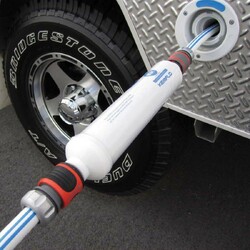
An inline water filter fits between the tap and your hose, catching contaminants before they reach the tank. It is the single most effective thing you can do to keep water tasting clean over the long term. If you are weighing up options, we have compared them in the best inline water filter for a caravan.
Pair it with a proper drinking water hose. A standard garden hose will reintroduce a plastic taste on its own, which catches a lot of people out after they have gone to the trouble of cleaning the tank.
Along with food-grade hoses and a clean tank, steady water pressure helps prevent stagnation in the plumbing lines, where biofilm can take hold. If your current setup is struggling to maintain pressure or the pump is cycling constantly, a reliable unit such as the Seaflo RV Supreme MK2 12V water pump will keep flow consistent throughout the system.
Browse the full caravan plumbing range for tanks, fittings, filters and pumps.
Is a plastic taste dangerous?
Usually, it is unpleasant rather than harmful, particularly in a new tank. But it can also indicate biofilm, which is worth dealing with properly.
How often should I sanitise the tank?
At the start of each season, and any time the van has sat unused for more than a month or two.
Will a filter fix an existing plastic taste?
Not on its own. A filter stops new contaminants from entering. If the taste is already in the tank, sanitise first, then fit the filter to keep it clean.
What size tank do I need anyway?
If you are still planning your setup, our helpful guide on what size water tank do I need for off-grid camping works through it.


Add your favourites to cart

Select Afterpay at checkout

Log into or create your Afterpay account, with instant approval decision

Your purchase will be split into 4 payments, payable every 2 weeks
All you need to apply is to have a debit or credit card, to be over 18 years of age, and to be a resident of country offering Afterpay
Late fees and additional eligibility criteria apply. The first payment may be due at the time of purchase
For complete terms visit afterpay.com/terms